Wine Regions
From Cornwall to Yorkshire, Wales to the Isle of Wright our wines cross the nation. Learn about our regions and deep dive into our 5 largest-producing counties: Sussex, Kent, Essex, Hampshire and Surrey.
We have growers in Cornwall all the way to Yorkshire, Wales to the Isle of Wight, and recently even Scotland. Learn about our regions and deep dive into Sussex, Kent, Essex and Hampshire.
Our industry remains relatively young in the world of wine. While distinct regionality is starting to develop, we are still in the very early stages. Regional identities are beginning to take shape, echoing the evolution of the world’s great wine regions. Clusters of grower producers are coming together, united by shared soils, microclimates, and a growing sense of place.
The regions here are grouped by political county boundaries, the real diversity lies beneath the surface in geology, aspect, and climate. Counties in the East, like Essex and Kent, enjoy warmer conditions and consistently produce grapes with higher sugar levels. Cooler areas to the West and the North demand more precision, but with thoughtful site selection, exceptional wines are emerging from every corner of England and Wales.
Largest 5 counties
kent
The closest to the English Channel and the most densely planted, Kent has firmly earned its place on the map. Known as the Garden of England, its rich fruit-growing heritage has made the transition to viticulture feel effortless. Warmer, drier conditions give Kent an edge, particularly for Chardonnay, which thrives here and anchors both its acclaimed traditional method sparkling wines and an exciting new wave of stills.
Once a destination for pilgrims heading to Canterbury, Kent is now drawing a new kind of visitor: wine lovers seeking a true taste of England.
Sussex
The birthplace of traditional method sparkling made from Chardonnay, Pinot Noir and Pinot Meunier, Sussex combines heritage and innovation. Sussex stretches to the south coast and intersected by the chalky South Downs, and the county is where English wine truly came of age.
From pioneer estates to bold newcomers, Sussex grower producers are crafting a diverse range of styles, but traditional method sparkling remains its flagship product.
Sussex also boasts the UK’s first regional PDO, stipulating a minimum of 15 months in bottle and a focus on the classic Champagne varieties.
Essex
Often dubbed England’s Côte d’Or, Essex is quickly establishing itself as the UK’s still wine powerhouse.
The Crouch Valley leads the charge, where low elevations, ample sunshine, and reflective light from the River Crouch combine with London clay soils to produce standout Pinot Noir and Chardonnay. Alongside Bacchus, varieties like Pinot Blanc, Sauvignon Blanc, and Pinot Gris are showing real promise, broadening the region’s reputation for quality and innovation.
Hampshire
The coolest of the UK’s larger wine regions, Hampshire produces wines defined by finesse, purity, and length. Its extended growing season allows for slow, even ripening, perfect for crafting sparkling wines with distinctive elegance and precision.
Centred around the historic city of Winchester – the ancient capital of England – Hampshire is home to the country’s oldest commercial vineyard and combines established and new wave producers. Most vineyards are nestled in the chalklands of the South Downs, spanning the Test, Itchen, and Meon River valleys, an area long celebrated for its crystal-clear chalk streams and watercress beds.
Today, Hampshire earns its acclaim for its refined traditional method sparkling wines, made primarily from Chardonnay, Pinot Noir, and Pinot Meunier. It’s a region where heritage, terroir, and cool-climate brilliance converge.
sURREY
Surrey wine producers may appear to operate somewhat in the shadow of their larger neighbours, but the county is home to what was, until recently, the largest single-estate vineyard in the UK.
A growing number of estates nestled within the Surrey Hills National Landscape are making the most of the region’s rolling chalk and Upper Greensand hills to produce premium traditional method sparkling wines, refined rosés, and distinctive low-intervention styles.
Sustainability is a key focus across the region, with organic and biodynamic practices in play—including the UK’s first vineyard and winery to achieve Net Zero status.
REGIONS BY ASSOCIATIONS
South East
The South East is home to over half of the UK’s vineyards. Spanning East Sussex, Kent, London, Surrey, and West Sussex, it’s the powerhouse of production and the spiritual centre of the industry.
The region’s signature chalk soils, running through the North and South Downs, have drawn inevitable comparisons to Champagne. But the story goes deeper – Greensand, Wealden and London clay add layers of diversity, shaping a wide range of styles and expressions.
Renowned as the cradle of traditional method sparkling wine in the UK, the South East is now turning heads with its still wines. Positioned just a short drive or train ride away from London, these vineyards offer the perfect escape for wine lovers in search of world-class bottles and countryside charm.


East
The East covers Bedfordshire, Cambridgeshire, Essex, Hertfordshire, Norfolk, and Suffolk. It is home to some of the UK’s warmest and driest vineyards – prime conditions for still wine. Longer ripening seasons and higher natural sugar levels make this one of the most exciting regions for expressive Pinot Noir and Chardonnay. Bacchus thrives here too, delivering aromatic, characterful whites that are distinctly English.
A few years ago in 2022, scientists from the University of East Anglia and the London School of Economics predicted that, due to rising temperatures, this region could become the wine producing capital of the UK within the next 15 years. Vintages similar to the exceptional 2018 would likely become the norm.
Wessex
From the deep chalk soils of Hampshire, wide valleys of Wiltshire, to Dorset’s Jurassic Coast, and the unique microclimate found on the Isle of Wight, an abundance of contrasting characteristics makes Wessex one of England’s most diverse winemaking regions.
Representing the majority of wine production in Wessex, the region’s traditional method sparkling wines made from Chardonnay, Pinot Noir and Pinot Meunier consistently capture attention and critical acclaim. However, an increasing amount of still wine is being produced from Germanic and disease resistant grapes including Bacchus, Pinot Blanc, Pinot Gris, Seyval Blanc and Cabernet Noir, as well as experimental plantings of vines not usually grown in the UK, such as Tempranillo and Viognier.

West
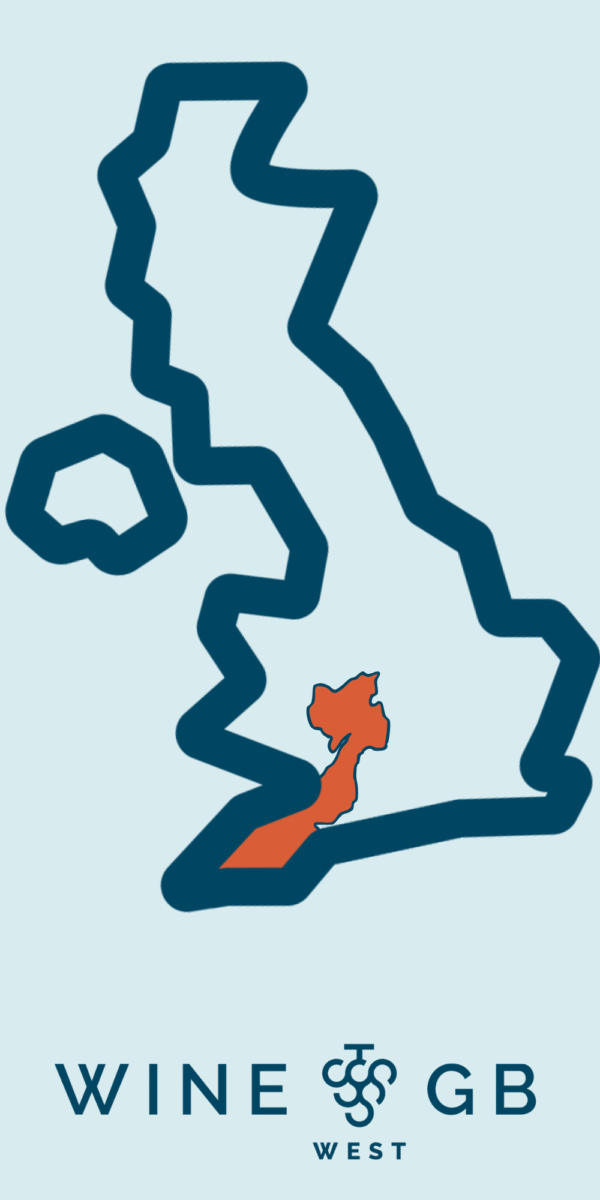
The West encompasses Avon, Cornwall, Devon, Gloucestershire, Herefordshire, Somerset, Worcestershire, the Isles of Scilly and the Channel Islands. You could say The West offers the best of all worlds. Stunning coastlines and secluded island escapes combine with inland natural landscapes, like Somerset’s Mendip Hills and Dartmoor National Park in Devon, providing varied terroir capable of cultivating a wide range of grape varieties and wine styles.
The maritime climate and diverse terroir here have enabled winemakers to produce some spectacular still and sparkling wines, and many have been doing so for decades. It’s also home to the only British vineyard to hold two Royal Warrants for sparkling wine – one from King Charles III and another from WineGB President, Queen Camilla.

Thames & Chilterns
With its English chalk downland, sweeping valleys and the River Thames running through it, Thames & Chilterns flourishes as a winemaking region. It covers the three counties of Berkshire, Buckinghamshire and Oxfordshire to the west and north west of London, it only accounts for about 3% of Britain’s vineyards but has some well-established names making great wines of provenance.
The most planted grapes are Chardonnay, Pinot Noir and Pinot Meunier for making sparkling wine, with the Chilterns chalk hills and gravel and flint soils of the Thames Valley working to deliver nuanced styles across the region. Bacchus is also grown well here, producing fruity and floral still wines with a quintessentially English flavour.
Wales
The first commercial vineyard in the UK was planted in Wales, in 1875 near Castell Coch, just outside Cardiff. 150 years on and while that vineyard no longer exists, the region’s winemaking industry is thriving. There are nearly 60 registered vineyards that produce a deliciously diverse range of high-quality wines.
Monmouthshire in the southeast of Wales and Carmarthenshire in the southwest are the top counties for plantings. But vineyards are spread throughout the country from Anglesey and the Llyn peninsula in the northwest, across to the Vale of Clwyd, in mid-Wales, down to the Vale of Glamorgan, the Gower, and all the way out west to Pembrokeshire and Ceredigion.

Wales is a particular hotspot for winemakers favouring a low-intervention approach. But all styles of wine are produced from traditional method sparkling and conventional still wines, through pét-nat, col fondo, orange wines and even a Port-like fortified wine made from Regent.
The climate in Wales means grapes like Seyval Blanc and Solaris thrive here, although several vineyards successfully grow classic varieties such as Chardonnay, Pinot Meunier and Pinot Noir. The region’s red wines have won acclaim – these are often made from Pinot Noir Précoce, Regent and Rondo, while more recent planting including Divico and Caberet Noir are now producing wines which garner praise.

Midlands & North
The largest of our wine regions by geographic span, Midlands & North stretches from the rolling plains of Cheshire and the limestone-rich hills of Derbyshire to the rugged coasts of Lancashire, the fertile flats of Lincolnshire, and even as far north as Fife in Scotland. Across this vast area, vineyards are shaped by diverse soils—from chalky ridges ideal for crisp whites to alluvial river valleys that lend a softer texture to still wines.
Cooler temperatures have historically favoured early-ripening varieties such as Solaris and Seyval Blanc, producing bright, aromatic wines with refreshing acidity. However, as the climate warms, adventurous producers are trialling Chardonnay, Pinot Noir, and other southern stalwarts, crafting elegant sparkling wines and delicate reds that show surprising depth for this latitude.
Though smaller in commercial volume than their southern counterparts, these vineyards are rich in character and community spirit. Many are family-run, often integrated with working farms or country estates, and they make the most of their surroundings by pairing wine with rural tourism—offering vineyard walks, cellar door tastings, and curated wine trails that wind through some of England’s most unexpected viticultural landscapes.